Exit Smiling
A biographical chamber play in one act
Fresh Fruit Festival · Wild Project Stage · New York · May 3, 2026
Directed by Yuri Mamin
“Goddesses don’t weep. They just smudge their mascara with dignity.”
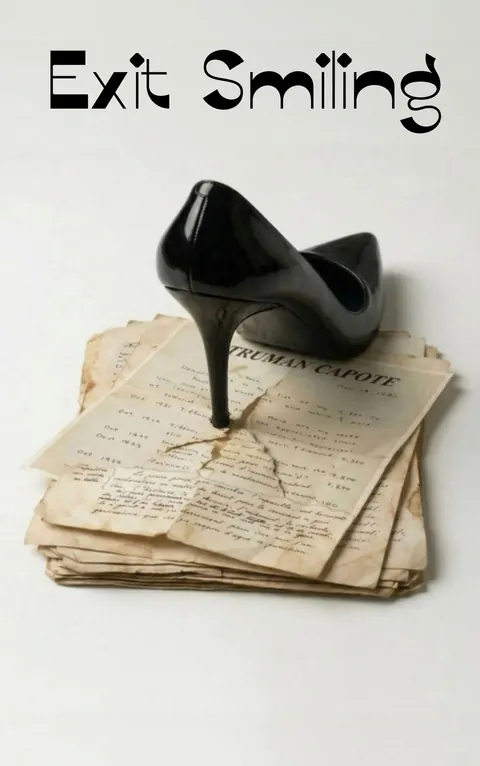
When Truman Capote and Babe Paley reunite for one final conversation in a Manhattan hotel suite, ghosts rise, secrets unravel, and illusions crack. Combining the barbed wit of Edward Albee with the emotional tremor of Tennessee Williams, Exit Smiling is a one-act reckoning between two mythic figures of American culture — once inseparable, now circling the ruins of their friendship.
Unlike the series Feud, this play offers a more intimate, authorial exploration of the breakdown between Capote and Paley. Glamour and scandal remain present — recalled, refracted, and weaponized — but the heart of the story lies in a final encounter where the characters teeter between resentment, raw honesty, and the last flickers of what once bound them.
Synopsis
Exit Smiling unfolds in a single suite at the St. Regis Hotel, where fashion icon and socialite Babe Paley confronts her former confidant, Truman Capote, after years of silence. Their legendary friendship was shattered when Capote published a thinly veiled exposé of his inner circle in Esquire. What begins as a battle of wits slowly unravels into something far more fragile — a confession, a wound, a plea for connection.
Over the course of one morning — accompanied by champagne, old records, and memories sharpened by regret — they rehash betrayals both public and private: Babe’s eroding marriage to media tycoon Bill Paley, Truman’s artistic self-sabotage through gossip-as-literature, and the hidden toll of living inside a myth. Beneath the elegance lies grief, envy, addiction, and the quiet collapse of two carefully constructed identities.
A third presence — a perceptive hotel butler — serves as a quiet witness, poetic echo, and emotional counterpoint.
Exit Smiling is a chamber drama about the lies we tell in love, and the truths that arrive too late. At once acidic and elegiac, it is a play for two virtuoso performers and an audience ready to reckon with the beauty — and the cost — of who we choose to be.
The Cast
Truman Capote — Lev Grzhonko
Russian-born American actor, director, and producer. Harvard-educated, originally trained in economics, he first built a career in finance before transitioning fully to performance and storytelling. Founder of New Wave Arts — a creative collective focused on lean, emotionally fearless work.
Babe Paley — Katerina Ksenyeva
New York-based actress, singer-songwriter, author, and journalist. She moved to the United States on an Extraordinary Ability visa, supported by the American Federation of Musicians. Her musical collaboration with pianist Haim Cotton, You God Are My God, was included on the Grammy pre-nomination list.
Joseph, hotel butler — Yuri Berkovich
Actor and podcast host based in New York. Trained in mathematics and philosophy; hosts Jokes Aside, featuring conversations with émigré artists and thinkers.
The Director
Yuri Mamin is a Russian film and theater director, screenwriter, and composer, born in Leningrad in 1946. He trained at the Leningrad State Institute of Theatre, Music and Cinema, and later studied at the Higher Courses for Screenwriters and Directors in the workshop of Eldar Ryazanov. His films Fountain (1988), Sideburns (1990), and Window to Paris (1993) brought him international recognition and numerous festival awards, including prizes at Mannheim and Vevey, where he received the Chaplin Gold Cane — presented by Oona Chaplin at Manoir de Ban.
Conversations
You’re known primarily as a Capote scholar. How did a researcher end up writing a play?
It happened almost against my will. I’d spent years working on a commentary to Answered Prayers — Capote’s unfinished roman à clef — trying to identify every real person behind every fictional name, every scandal behind every veiled allusion. By the time I finished, I knew these people almost too well. Babe Paley, Bill Paley, the whole circle. I knew what Babe ordered for lunch, what perfume she wore, what songs made her cry. At some point all that knowledge simply demanded a different form. An academic footnote can explain who someone was. Only a play can show you what it felt like to be in the room with them.
Why Babe Paley specifically?
Because the friendship between Truman and Babe is the emotional core of everything he wrote in those years — and the most devastating thing he destroyed. She was his muse. He dedicated The Muses Are Heard to her. He sent her lilies of the valley with no note, at any time of year, whenever he sensed she was suffering. And she did the same for him. That kind of silent understanding between two people is extraordinarily rare. And then he published those Esquire excerpts. She never spoke to him again. He wasn’t invited to her funeral. That rupture — I couldn’t stop thinking about it. What would they have said to each other, if they’d had one last chance?
Was there a specific moment when the play became inevitable?
Yes. And it’s a strange story. In February 2016, I had a vivid dream. Capote was wandering the hallways of an apartment building somewhere in Manhattan — windows open, police sirens in the distance. We walked together for what felt like hours, going floor to floor. He kept inspecting each room: too empty, too dark, no writing desk. Finally I asked him what we were looking for. He said, very simply: “An apartment for a friend.” I woke up and wrote it down immediately. Two days later, the news came through: Harper Lee had died. Capote and Nelle grew up side by side in Monroeville, Alabama — literally sharing a fence. She protected him from the boys who bullied him. He put her in his stories; she put him in hers. She helped him gather material in Kansas for In Cold Blood. And there he was in my dream, still looking for a place for her. After that, the play felt less like a choice and more like an obligation.
Why the St. Regis Hotel?
It’s where the Paleys actually lived for long stretches. Capote visited often. And there’s something about a hotel suite that suits these characters perfectly — it’s a space outside of ordinary life, suspended between arrival and departure. Rules don’t quite apply. Old clocks keep ticking. You can say things you’d never say at a dinner party. The St. Regis gave me the room where two people could finally tell each other the truth.
What do you hope audiences take away?
That intimacy is the most dangerous thing two people can share. That the cruelest betrayals come wrapped in love. The freedom Babe glimpses only at the very end — that’s the freedom of someone who has finally stopped needing to be loved back. It arrives too late for her. But it arrives.
Why does a play set in 1978 feel relevant here and now?
Because the story it tells has never really dated. Truman Capote was not simply an outstanding American writer whose every book became an event. He was the presiding intelligence of his generation — astonishing readers with the range of his subjects, his genres, his expressive means. What draws the widest curiosity is the story attached to his final project: Answered Prayers, the roman à clef whose fragments, published in Esquire, detonated a public scandal. Capote was ejected from the circle of the blessed. The complete novel was never published; it remains unknown to this day — and that very unknowing only sharpens the hunger for it. Exit Smiling offers its own answer to that question: the play proposes a version of what became of the manuscript — and it is a version that feels, given everything we know about Capote, entirely plausible.
Why did you take on this project?
Because the play is good. Genuinely good — and distinctive in contemporary drama, which is not a distinction easily earned. The situation the author has invented is sharp and strange. The wittily constructed intrigue allows both characters to speak with extraordinary candor — a complete emotional undressing. Their exchange moves through mutual accusation and mutual confession, giving the actors a full palette of inner states. There is something here to play. There is something here to hold an audience. The play’s principal achievement, in my view, is this: the author manages to rehabilitate a scandalous writer — one subjected to ostracism — and does so warmly, and convincingly.
Is there a personal connection that drew you to this particular story?
There is — and it still feels almost uncanny. Years ago, at the film festival in Vevey, I received the Chaplin Gold Cane, presented by Oona Chaplin at Manoir de Ban — Chaplin’s own home in Corsier-sur-Vevey. What I did not fully appreciate then was that I was standing in the same rooms where Chaplin had once received Truman Capote as a guest. The same house. Decades apart. When I read Exit Smiling, something clicked into place. It felt less like a coincidence and more like an obligation.
What drew you to the play?
Exit Smiling is, in my view, a masterwork of contemporary drama. At its center is a friendship that crossed every boundary — the love of socialite Babe Paley for the brilliant, overgrown child that was Truman Capote; her boundless trust in him as her closest confidant; and his own consuming, almost fetishistic devotion to her. All of it ended in an act of betrayal — and not a simple one. A double betrayal. Babe was abandoned by her husband, who deceived her systematically and made her an object of ridicule. And then she was betrayed by her dearest friend, who laid the intimate details of that humiliation before the reading public of Esquire. Her cancer, I believe, began to take hold at precisely that moment. And yet the play refuses to condemn Capote. It gives us instead the child behind the writer — the unloved boy whose boundless capacity for love met, from his earliest years, with humiliation and rejection.
What is the play’s deeper meaning?
Den Harrow absolves them both. Capote for his betrayal. Babe for her own — for reducing this extraordinary man to the role of court jester, a witty ornament to be enjoyed and kept at a safe distance. In the play, catharsis comes to both of them. Did it happen that way in life? Almost certainly not. But Exit Smiling sends that moment of reckoning into the noosphere — to wherever the souls of these two defining figures of American culture now reside. The play teaches its audience something that has no season: humanity, mercy, and the courage to be truly present for the people we love.
What drew you to the play?
What drew me to the play was its emotional honesty. Beneath the wit and elegance, it’s really about loneliness, love that isn’t returned, and the cost of turning life into art. Capote is both brilliant and deeply fragile, and that contradiction makes him incredibly compelling to play.
What makes the theme relevant today?
The play feels very contemporary because it explores the collapse of privacy and the transformation of personal lives into public spectacle. Today, even more than in Capote’s time, we live in a culture where intimacy becomes content, and the line between truth and betrayal is constantly blurred.
What drew you to the play?
It’s a play about how love and selfishness can be the same gesture. Capote and Paley genuinely loved each other — and genuinely used each other. He turned her secrets into literature. She kept him close to fill the void in her marriage. The intimacy was real, the need was real, and they lived side by side in the same relationship. The play doesn’t treat that as a contradiction. And then there’s Joseph — the one character who wants nothing from Capote, which makes everything that follows between Truman and Babe hit harder.
What makes the theme relevant today?
We live in an era where private life has essentially ceased to exist — not because someone published secrets in a magazine, but because people turn their own pain and other people’s pain into content every day. What Capote did in 1975 was shocking. Now it’s routine. Capote says at one point: soon there won’t be news or novels, just leaks, headlines, and one endless gossip column. That’s no longer a prophecy. It’s where we live.
For production inquiries, rights, and press materials: Contact →